Advanced Thrust Nozzle
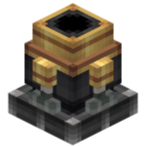
A nozzle that can point anywhere inside a 15° cone
The Advanced Thrust Nozzle (ccpe:advanced_thrust_nozzle) is the upgraded version of the directional thrust nozzle. It mounts exactly the same way — on the airflow face of a Create encased_fan, still powered by the fan's RPM — except that the nozzle body can tilt around a pivot at its base. Thrust follows the tilted axis, so a single nozzle can push a craft in any direction inside the cone.
Tilting is driven by CC:Tweaked Lua in two frames and three flavours: polar (azimuth + tilt angle), joystick (x/y = -1..1), and thrust semantics (x/y/z = desired thrust direction) — the last one is what control code should use. None of them teleport: the nozzle sweeps to the new direction at a constant speed in the deflection plane, and the render, thrust, and exhaust/intake/contrail particles all animate together.
⚠️ Polar and joystick describe where the nozzle deflects in the model frame (i.e. where the exhaust points), not where the thrust points — thrust is the opposite, and the two lateral components do not share a sign. Control scripts should use
setThrustDirection(x, y, z); the reason is in "Frames: why joystick ≠ thrust" below.
Compared to the directional nozzle
Directional nozzle ccpe:thrust_nozzle |
Advanced thrust nozzle ccpe:advanced_thrust_nozzle |
|
|---|---|---|
| Thrust direction | FACING only | Anywhere inside a 15° cone around FACING |
| Output per RPM | 1 pN/RPM | 2 pN/RPM (same fan, twice the output) |
| Lua control | none (fan RPM only) | setDeflection / setDirection / setThrustDirection / setThrustScale |
| Channel | — | Physics-body scoped, addressable from Lua |
| Right-click GUI | — | Channel wheel |
| Exhaust / contrail / dye / wrench | ✅ | ✅ all inherited — and they follow the tilted axis |
Placement
- It must occupy the airflow face of an
encased_fan(samecanSurvivecheck ascreate:nozzleand the directional nozzle). FACING is decided solely by the fan behind it. - The fan's own thrust is always 0 once a nozzle is installed there, so the nozzle is the only thrust source — nothing stacks.
- Right-click with an empty hand opens the channel GUI; right-click with a dye recolors the contrail particles only (goggles show the current color in the tooltip).
- Sneak-right-click with a wrench removes it instantly (drops go straight into your inventory). A normal wrench right-click does not rotate it — the only legal FACING is the fan's airflow face.
Channel & addressing
The channel number is the nozzle's address inside the physics body, sharing one channel space with the short-range signal linker and the control desk (1:1 per channel within a body).
- The lowest free number on the chain is assigned automatically on placement; when two devices on the same chain claim one channel, the later one defers to the next free number.
- Devices register only on physics bodies (Sable sub-level, including the constraint chain). A nozzle sitting on the ground is not registered:
getChannel()returns-1and the GUI shows "Must be placed on a physics body". - The assignment is re-checked every 20 ticks, so bearings linking/unlinking (which merges or splits channel spaces) can push the number along.
- Leaving the physics body resets the channel to
-1; re-mounting assigns a new one. - Unlike the linker, the nozzle GUI has no "load physics body" switch — the nozzle holds no force-load ticket.
Address it from Lua through the same ccpe.sensor_system module:
local ss = require("ccpe.sensor_system")
local n  = ss.getPeripheral(0)        -- the nozzle on channel 0
print(n.getChannel(), n.getMaxTilt()) -- 0  15
Lua API
Peripheral type: advanced_thrust_nozzle (obtained via ccpe.sensor_system.getPeripheral(channel)).
| Method | Returns | Description |
|---|---|---|
setDeflection(azimuthDeg, tiltDeg) |
boolean | Polar form: azimuth around the FACING axis (0–360, negatives wrap), tilt clamped to 0..15. Only the target is written; the nozzle sweeps there in a straight line. Returns false for non-finite input |
setDirection(x, y) |
boolean | Joystick form: x/y ∈ -1..1, where the direction is the azimuth and the length maps (circularly) to the tilt angle (length 0 = straight, 1 = full 15°). Inputs are clamped to -1..1 each and then to the unit circle, so (1,1) equals "45° direction at full tilt". Target-only, same straight-line motion |
getDeflection() |
table | {azimuth, tilt, targetAzimuth, targetTilt, x, y, targetX, targetY}: the first four are the actual values right now (different from the targets while moving), the targets come last. Azimuths are normalized to 0–360 (meaningless — reported as 0 — when the point sits at dead center); x/y are the actual deflection point in degrees (tilt · (cos, sin) azimuth), directly comparable with setDirection |
getMaxTilt() |
number | Tilt clamp (currently 15), handy for normalizing scripts |
isMoving() |
boolean | Whether it is still animating (deflection or thrust scale not settled) |
getThrustDirection(x, y) |
table / nil | Read-only thrust-semantics mirror: takes the same arguments as setDirection and returns the settled thrust direction (unit vector {x, y, z} in the plot / body frame). The current output sign is already applied (setInverted(true) flips the reported direction). Meant for self-checks / calibration — compare it against what the script expects. Reports the steady state for the target deflection, not the in-flight value; returns nil for non-finite input or off the server |
setThrustDirection(x, y, z) |
boolean | Write in thrust semantics (recommended for control code): pass the direction you want the craft pushed toward (plot / body frame, no need to normalize) and the deflection is solved for you. Only the component perpendicular to the FACING axis is used (for a downward nozzle: (1,0,0) = east, (0,0,1) = south), and the FACING lateral mirror, fan rotation sign and setInverted are all absorbed ⇒ no re-calibration when you change the craft or the mounting. Length is clamped to 0..1 and mapped to tilt (1 = full 15°); the axial component is ignored (tilt cannot reverse axial thrust — use setInverted for that); a zero vector returns false |
getProfile() |
table / nil | Mounting and sign snapshot (for debugging / logging): {facing, inverted, speed, axisStep, thrustSign, maxTilt}. speed is the signed RPM of the fan behind it (0 with no air source / not spinning), axisStep is ±1 for the FACING axis, and thrustSign is κ = sign(axisStep · speed · inverted) (impulse = −axis · κ; treated as +1 when speed = 0) |
setThrustScale(scale) |
boolean | Output scale 0..1 (clamped), multiplied on top of "RPM × air pressure". Also drives the exhaust and intake particles (see "Output and particles"); animated along the same motion curve |
getThrustScale() |
number | Current output scale (0..1, the live value while animating) |
setInverted(enabled) |
boolean | Output reversal (thrust ⇄ suction): true flips the sign of the force along the axis at the same RPM and output scale (forward thrust becomes suction; negative-RPM suction reverses too). Instant, no animation; only the sign flips — magnitude (RPM / pressure / output scale) and pointing direction are untouched — and the particle chain swaps with it (exhaust ⇄ intake). Stored in NBT / blueprints |
isInverted() |
boolean | Whether output is currently reversed (true = force along the axis is flipped, i.e. thrust acts as suction) |
getChannel() |
number | Channel of this nozzle inside the physics body (-1 = not on a body / unassigned) |
getForcePoint() |
table | The nozzle's force application point {x, y, z} in the physics body's local frame, relative to the body origin (the centre-of-mass pivot) — use it as the moment arm r in τ = r × F. The point is the block centre, which is exactly where Sable applies the force (propM* in the flight recorder uses the same point); the nozzle mouth is this point plus axis × 0.55 blocks, but the offset is collinear with the force, so both give the same torque. Same frame as getSensors().pos (that one is the block corner; this method adds +0.5). Constant while the body moves/rotates; returns nil when not on a body |
Frames: why joystick ≠ thrust
The same nozzle is described by two coordinate systems, and mixing them is the easiest mistake on this block:
| Concept | Frame | Meaning |
|---|---|---|
setDeflection azimuth / setDirection x, y / getDeflection().azimuth |
model frame | Where the nozzle / exhaust deflects. With FACING=down: model +X → plot +X, model +Z → plot −Z, model +Y → plot −Y |
setThrustDirection x, y, z / getThrustDirection return value |
plot / body frame | Where the craft is pushed — same frame as getForcePoint() / getSensors().pos |
Three effects stack up so that "joystick" and "thrust" are not a simple negation:
- Thrust is the opposite of the exhaust direction — tilt the exhaust east and the craft is pushed west;
- the
FACING=downmodel frame is mirrored against the plot frame:xhappens to line up whilezflips. Thexdoc is accidentally correct in both frames, which is exactly what misleads people into assumingyis too; - the output sign
κ = sign(axisStep · fan RPM · inverted)flips everything once more.
The net result (FACING=down, negative RPM, not inverted, i.e. κ = +1) in the plot frame is:
This is not a typo: flipping the axis requires a 180° rotation, and its determinant on the perpendicular plane is always −1 (it is a reflection, not a rotation), so the lateral mapping between "stick" and "thrust" always contains one mirror — the two components can never share a sign.
Hand-negating therefore only works for four downward nozzles on the same wiring.
setThrustDirection(x, y, z)moves all of those signs into Java so control code never hard-codes them; when in doubt, read the real signs withgetProfile()instead of deriving them.
Example
local ss = require("ccpe.sensor_system")
local n  = ss.getPeripheral(0)

-- polar form: azimuth 90° at full 15° tilt (sweeps there in ~0.19 s)
n.setDeflection(90, 15)
n.setThrustScale(0.5)                  -- half output (thrust and exhaust/intake halve together, also animated)
print(n.getDeflection().tilt, n.getThrustScale())

-- wait until it settles
while n.isMoving() do sleep(0.05) end
print(n.getDeflection().azimuth, n.getDeflection().targetAzimuth) -- equal

-- joystick form: direction = azimuth, length = tilt (goes straight)
n.setDirection(1, 0)                   -- full tilt toward model +X (= setDeflection(0, 15))
n.setDirection(0, -1)                  -- full tilt toward model −Z (= setDeflection(270, 15))
n.setDirection(0.5, 0)                 -- toward +X at half tilt (7.5°)
n.setDirection(0, 0)                   -- back to straight

-- [recommended] thrust semantics: x / y / z = the direction you want to be pushed
n.setThrustDirection(1, 0, 0)          -- full push east (downward nozzle; ignores FACING / inv / RPM)
n.setThrustDirection(0, 0, 1)          -- full push south
n.setThrustDirection(0.1, 0, 0)        -- push east at 1.5° (0.1 = 1.5 / 15, handy for small-angle calibration)
n.setThrustDirection(0, 1, 0)          -- the axial direction of a downward nozzle ⇒ straight out (axial part ignored)

-- self-check / calibration: given a stick input, where does thrust actually point?
local d = n.getThrustDirection(1, 0)   -- for a downward nozzle with κ=+1: {x≈-0.259, y≈0.966, z≈0}
print(d.x, d.y, d.z)

-- mounting snapshot: print this first when debugging
local prof = n.getProfile()            -- {facing="down", inverted=false, speed=-256, axisStep=-1, thrustSign=1, maxTilt=15}
print(prof.facing, prof.speed, prof.thrustSign)

-- output reversal (thrust ⇄ suction): instant, exhaust switches to intake
n.setInverted(true)                    -- force flips along the axis
print(n.isInverted())                  -- true
n.setInverted(false)                   -- back to normal direction

-- force application point (body frame, for torque): the body origin ≈ COM, so use it as r directly
local p = n.getForcePoint()            -- {x=…, y=…, z=…}; nil when not on a body
-- torque τ = r × F, where F is this nozzle's thrust in the body frame (along the tilted axis,
-- sign set by RPM / setInverted)
For setDeflection / setDirection, azimuth 0° is the model's +X direction and 90° is +Z ((cos, sin) maps to (x, y)), and the whole frame rotates with the block's FACING; setThrustDirection / getThrustDirection use the plot / body frame instead (see "Frames: why joystick ≠ thrust" above).
Thrust model
- Full output on a vector nozzle = 2 pN/RPM; pressure comes from
DimensionPhysicsData(1.0 at sea level, dropping with altitude). - Sign convention (uniform across all six FACINGs): thrust is always opposite the airflow direction, and the airflow direction = tilted axis ×
κ(κ = axisStep · RPM sign · inverted). Thanks to theaxisStepcompensation every mounting collapses to one rule: a vertical nozzle always pushes down at positive RPM and up at negative RPM, whichever way it is mounted; horizontal nozzles likewise push toward the negative side of their axis.κ > 0renders exhaust,κ < 0renders intake. When unsure, readaxisStep/speed/thrustSignfromgetProfile(). - Thrust is never occlusion-checked — a blocked nozzle still pushes (same as the directional nozzle).
- The thrust scale also drives the exhaust and intake particles (see below), but not the high-altitude contrail.
setInverted(true)only flips the sign (thrust ⇄ suction): magnitude and every other parameter stay identical, and the particle chain swaps from exhaust to intake in the same step.
| Fan RPM | Pressure | setThrustScale |
Thrust |
|---|---|---|---|
| 256 RPM | 1.0 | 1.0 | 512 pN |
| 256 RPM | 1.0 | 0.5 | 256 pN |
| 128 RPM | 1.0 | 1.0 | 256 pN |
| 256 RPM | 0.5 | 1.0 | 256 pN |
Tuning constants
| What you want to change | Constant | Current value |
|---|---|---|
| Deflection speed (animation and real thrust together) | AdvancedThrustNozzleBlockEntity.DEFLECTION_DEG_PER_SECOND |
160°/s (= 8°/tick) |
| Vector nozzle output | AdvancedThrustNozzleBlockEntity.THRUST_OUTPUT_MULTIPLIER |
2.0 (2 pN/RPM) |
| Thrust-scale ramp | AdvancedThrustNozzleBlockEntity.THRUST_SCALE_PER_TICK |
0.25/tick |
| Maximum tilt angle | AdvancedThrustNozzleBlockEntity.MAX_TILT_DEG |
15° |
| Tilt pivot | AdvancedThrustNozzleRenderer.PIVOT |
(8, 5, 8) px |
| Selection / collision box | AdvancedThrustNozzleBlock.BASE_SHAPE |
(0,0,0,16,4,16) + (2,4,2,14,16,14) |