Flight Management Computer
A core capability of the Flight Management System (FMS) is estimating the aircraft's current mass and centre of gravity in real time from flight data, rather than relying only on numbers the crew entered beforehand.
- Mass estimation: in level flight, lift must equal weight. The FMS infers the current mass from the actual flight response — angle of attack, pitch trim and thrust: the heavier the aircraft, the more angle of attack or thrust is needed to hold the same flight path.
- CG estimation: the centre of gravity determines the required trim state, so the FMS can infer it from the elevator/stabilizer trim position; combining both yields an estimate of the aircraft's mass and CG.
- Continuous correction: before takeoff the crew enters the takeoff weight (fuel + payload); in flight the FMS keeps refining the estimate using fuel flow and measured flight characteristics.
Airbus displays the real-time estimated gross weight (GW) and centre of gravity (CG) on the MCDU performance page, dynamically updating the optimum cruise altitude, fuel predictions and approach speeds without the pilot having to enter an exact weight; Boeing's FMS has a similar weight-estimation mechanism.
FMC gate
The physics body must have at least 1 FMC (ccpe:fmc) installed, otherwise all the methods below return nil. They also return nil when the computer is not on a body, or the underlying physics data is unavailable.
| Method | Returns | Description |
|---|---|---|
getPhysicsCenterOfMassRel() |
table / nil | Center of mass relative to the block center of the most recently placed FMC (AIC counts as FMC), body-local {x, y, z} |
getPhysicsChainCenterOfMassRel() |
table / nil | Total center of mass of the whole chain, body-local {x, y, z} relative to the block center of the most recently placed FMC (AIC counts as FMC) |
getPhysicsMass() |
number / nil | Mass of the computer's physics body (kg) |
getPhysicsChainMass() |
number / nil | Total mass of the body including all constraint chains (kg) |
getPhysicsGravityForce() |
number / nil | Gravity force of the body (pN = mass × 11) |
getPhysicsChainGravityForce() |
number / nil | Total gravity force of the whole chain (pN = chain mass × 11) |
getStressRemaining() |
number / nil | Remaining stress (su) of the Create stress network the most recently placed FMC's attached block belongs to (negative when overstressed) |
getStressCapacity() |
number / nil | Total stress capacity (su) of that network |
Center of mass semantics
getPhysicsCenterOfMassRel() returns the body-local (plot-frame) offset of the center of mass from the block center of the most recently placed FMC on the body (including constraint chains; with several FMCs/AICs, the last one placed wins):
COM relative to FMC block center = (COM relative to the physics body origin) − (FMC block center relative to the physics body origin)
The FMC reference point is its BlockPos (corner) plus half a block (+0.5), i.e. the center of the block cell, not the block corner. Both offsets go through the Sable conversion plot − rotationPoint (same frame as the pos field in getSensors()), so the result does not change as the body moves or rotates — stable for identifying where the center of mass sits on the vehicle (e.g. how far forward/up it is from the FMC's center).
Body origin = center of mass
Sable keeps the physics body origin (rotationPoint) in sync with the center of mass at runtime, so the first term above is ≈ 0 and this value is ≈ the FMC block center's own offset from the body origin, negated (i.e. where the COM sits relative to the FMC's center).
- Use
getOrientation()to rotate this vector into the world frame if needed.
Chain center of mass
getPhysicsChainCenterOfMassRel() returns the total center of mass of the whole physics chain (including constraint connections such as bearings; always including the computer's body), as a body-local offset relative to the block center of the most recently placed FMC on the body (including constraint chains; with several FMCs/AICs, the last one placed wins):
chain COM rel. to FMC block center = (chain COM rel. to the computer's body origin) − (FMC block center rel. to the computer's body origin)
The first term is the mass-weighted average of each body's COM in world Σ(mᵢ·comᵢ)/Σmᵢ, inverse-transformed into the computer's plot frame − rotationPoint; the second term uses the same reference point as getPhysicsCenterOfMassRel() (the FMC's BlockPos corner plus half a block). The result is in the same frame as pos in getSensors() and stable under body motion/rotation.
Sable has no built-in chain COM API (MergedMassTracker only merges a single body itself plus the contraptions in its plot); this mod computes the value on the server every tick. Gated exactly like getPhysicsChainMass() (the body — including constraint chains — must have ≥ 1 FMC).
Gravity
Gravity force is a scalar (magnitude, pointing down) computed as:
getPhysicsGravityForce() uses the mass of the computer's own body; getPhysicsChainGravityForce() uses the chain total (see getPhysicsChainMass()).
Attached block stress network
getStressRemaining() and getStressCapacity() read the Create stress network of the block the most recently placed FMC (AIC counts as FMC) is attached to:
- attached block — the block on the FMC's support face (FMC: the face determined by its
FACE/FACINGblockstate; AIC: the block behind itsFACINGdirection). The attached block must be a Create kinetic block (KineticBlockEntity, e.g. a gearbox, shaft or propeller bearing), otherwise both methods returnnil. getStressCapacity()— total capacity of the network, in stress units (su).getStressRemaining()— remaining stress,capacity − current stress(su). Negative when the network is overstressed.
Both methods are gated exactly like the rest of the FMC methods (the body — including constraint chains — must have ≥ 1 FMC, and the computer must be on a body). The reading refreshes once per tick.
Example
local ss = require("ccpe.sensor_system")

if not ss.isOnBody() then
    error("computer not on a physics body")
end

print("mass (kg):        ", ss.getPhysicsMass())
print("chain mass (kg):  ", ss.getPhysicsChainMass())
print("gravity (pN):     ", ss.getPhysicsGravityForce())
print("chain gravity(pN):", ss.getPhysicsChainGravityForce())

-- Center of mass relative to the most recently placed FMC (body-local, stable under rotation)
local com = ss.getPhysicsCenterOfMassRel()
if com then
    print("COM rel to FMC:", string.format("x=%.2f y=%.2f z=%.2f", com.x, com.y, com.z))
end

-- Create stress network of the block the last FMC is attached to (su)
print("stress capacity (su): ", ss.getStressCapacity())
print("stress remaining (su):", ss.getStressRemaining())
Propeller speed tool
The FMC also provides a propeller speed solver (also FMC-gated): given the desired thrust and current flight state, it inverts the propeller physics model to compute the rotation speed the propeller bearings should output. The tool depends on aeronautics' propeller physics config.
initPropeller(N, S)
Must be called once before use:
-- N = number of propellers (Propeller Bearings)
-- S = number of power blocks per propeller (sails / sym sym sails / wool blocks)
local ok = ss.initPropeller(N, S)
| Argument | Description |
|---|---|
N |
Number of propellers (≥ 1) |
S |
Number of power blocks per propeller (≥ 1) |
Returns true on success; returns false when the body (including constraint chains) has no FMC (gate fails) or the arguments are invalid.
getPropellerRPM(F, P, V, θ?)
-- F = desired thrust; P = air pressure (sea level = 1.0); V = velocity (m/s)
-- θ = angle between the propeller plane and the velocity direction (degrees, optional, default 0)
local rpm = ss.getPropellerRPM(F, P, V, thetaDeg)
Formula (inverted from the aeronautics thrust/airflow model):
where T (Propeller Bearing Thrust, default 0.2) and A (Propeller Bearing Airflow, default 0.05) come from the aeronautics config (aeronautics > server > Physics). The values are cached once when entering the game (server start) and when an FMC is placed/loaded (static cache, not refreshed per tick) — after changing the config in-game, re-enter the world or re-place an FMC for the new values to take effect.
Returns the required speed R; returns nil when not initialized, when the gate fails (no FMC), or when arguments are invalid (e.g. P ≤ 0).
θ (airflow angle, degrees) scales the airflow term V × sin(θ) / (S^0.5 × A) — the extra speed a propeller needs because it is moving through the air it pushes. Usage convention:
- Fixed-wing level flight:
θ = 90— the air flows through the propeller disc, the airflow term applies in full (sin 90° = 1); - Helicopter vertical takeoff/landing:
θ = 0— no airflow term.
Default is 0.
Feed
getPressure()(static port reading) as pressure andgetSpeed()/getAverageSpeed()(pitot tube readings) as velocity to build a closed-loop thrust controller.
Altitude ↔ pressure conversion tools
Also FMC-gated (and therefore also available with an AIC), the sensor system provides two pure conversion utilities between world altitude Y and air pressure, using exactly the same atmosphere model as the game physics (and the static port reading getPressure()):
| Method | Returns | Description |
|---|---|---|
getPressureFromAltitude(Y) |
number / nil | Air pressure (fraction of sea level, sea level = 1.0) at world altitude Y |
getAltitudeFromPressure(P) |
number / nil | World altitude Y that has air pressure P (inverse of the above) |
Both are gated exactly like the FMC methods (the body — including constraint chains — must have ≥ 1 FMC, with AIC counting as FMC; the computer must be on a body), otherwise they return nil. They are pure math (mainThread = false): they read a cached copy of the atmosphere curve and never touch the world on the computer thread.
Calculation formula
The game atmosphere is P(Y) = basePressure × pressureCurve(Y), where the curve is a piecewise cubic Hermite interpolation over anchor points loaded from the dimension's dimension_physics datapack:
Default overworld anchors (basePressure = 1.0, sea level = 63):
| Altitude Y | Value | Slope |
|---|---|---|
| −38.37 | 1.5 (underground clamp) | −0.006 |
| 63 | 1.0 | −0.004 |
| 263 | 0.4493 | −0.001797 |
| 280 | 0.4198 | −0.001679 |
| 320 | 0 (build limit) | −0.02099 |
Between −38 m and ~280 m this is numerically identical to the simple exponential P ≈ e^(−0.004·(Y − 63)). Above 280 m the curve bends down toward 0 at the build limit (Y = 320) and stays 0 above it — at the default overworld ceiling there is no air (no lift / drag / thrust). The curve is not analytically invertible (piecewise cubic), so the inverse is computed numerically:
The bisection is monotonic and exact to double precision, so the two methods round-trip: getAltitudeFromPressure(getPressureFromAltitude(Y)) ≈ Y. The altitude datum is world Y — identical to getAltitude().
What is cached
To keep mainThread = false thread-safe, the curve parameters are copied once into a static volatile snapshot:
basePressure- the anchor points
{altitude, value, slope}(5 triples by default) - the bisection bounds
[minY, minY + logicalHeight]
The snapshot is refreshed once — at server start (using the overworld) and whenever an FMC or AIC is placed/loaded (onLoad) — mirroring the propeller config cache, not every tick. The gate (does this body have an FMC/AIC right now) is still checked every tick.
Cache freshness
After dimension_physics datapack changes (/reload), re-place/reload an FMC or AIC (or restart the world) to refresh the snapshot. The cache is global (one curve shared by all computers): with multiple bodies in different dimensions the last-loaded dimension's curve wins.
Sail aero tools
Also FMC-gated (and therefore also available with an AIC), the sensor system provides two pure-math utilities built around the two equations of the game's aero model — lift and directionless drag — for design math (trim, cruise-speed estimates, stall / minimum-pressure analysis) without needing live flight data:
Lift:             L = k3 × P × |V| = 0.475 × P × |V|          (regular sail only)
Directionless drag: D = k2 × P × |V| = 0.06888202261 × P × |V|  (regular & symmetric sails)
The formulas mirror Sable's BlockSubLevelLiftProvider.sable$contributeLiftAndDrag() (evaluated once per physics substep, per sail block). Both tools assume n·v = 0 — the airflow is perpendicular to the sail normal, i.e. no normal velocity component (level flight). Under this condition the normal (parallel) drag is zero, so the outputs reduce to lift + directionless drag only:
| Method | Returns | Description |
|---|---|---|
solveSailLift(P, V, L?) |
number / nil | Lift equation (Create SailBlock): pass any two of the three values, nil for the missing one, returns the third |
solveSailDirectionlessDrag(P, V, D?) |
number / nil | Directionless drag equation (regular & symmetric sails): same pattern |
Argument convention: pass any two, nil for the unknown
Each method is a unified solver for "given any two of the equation's quantities, return the third". The three parameters are air pressure P, speed V, and the output quantity (lift L / drag D). Pass any two, nil for the missing one, and the method returns the missing value:
-- Lift equation L = 0.475 × P × |V|
ss.solveSailLift(P, V, nil)   -- → lift L (forward)
ss.solveSailLift(P, nil, L)   -- → speed V = L/(0.475·P)     (level flight: L = weight → required airspeed)
ss.solveSailLift(nil, V, L)   -- → pressure P = L/(0.475·|V|) (minimum pressure for that lift → max usable altitude)

-- Directionless drag equation D = 0.06888202261 × P × |V| (same for both sail types)
ss.solveSailDirectionlessDrag(P, V, nil)   -- → drag D (forward)
ss.solveSailDirectionlessDrag(P, nil, D)   -- → speed V = D/(0.06888202261·P)
ss.solveSailDirectionlessDrag(nil, V, D)   -- → pressure P = D/(0.06888202261·|V|)
- Passing only 1 value, or all 3 →
nil(under-determined / over-determined). P— air pressure (fraction of sea level, sea level = 1.0, same semantics asgetPressure());P ≤ 0→nil.V— speed magnitude (m/s, same units asgetSpeed()); negative values are taken as|V|; when solving for P,|V| = 0(division by zero) →nil.L/D— force scalar; negative has no solution →nil.- Gated exactly like the other FMC tools (the body — including constraint chains — must have ≥ 1 FMC, AIC counting as FMC; the computer must be on a body), otherwise
nil. Pure math (mainThread = false), zero main-thread scheduling.
Returned values
The methods return the missing quantity as a per-second equivalent force scalar (force / m/s / pressure fraction) — substep-independent, same scale as the in-game diagram (impulse × 60), comparable to thrust readings. They no longer return per-substep impulses.
Formulas
Regular sail (Create SailBlock, all Sable defaults):
Directionless drag (shared by the regular and symmetric sails, k2 not overridden):
D = k2 × P × |V| = 0.06888202261 × P × |V|
V = D / (0.06888202261 × P)
P = D / (0.06888202261 × |V|)
The symmetric sail (Simulated SymmetricSailBlock: k3 = 0, k1 = 1.75) produces no lift — only directionless drag, computed by the same solveSailDirectionlessDrag (k2 identical to the regular sail).
k2 = 0.06888202261 (Sable's default, (−0.75 + √(0.75² + 0.475²)) / 2 — exactly the minimum damping that keeps the default lift from diverging). The normal-drag coefficient k1 (0.75 regular / 1.75 symmetric) never appears here because it multiplies (n·v), which is 0 by the tool's condition. With n·v = 0 the lift also takes its maximum for the given speed (|V − parallel drag| = |V|); any incidence/yaw component would only reduce it.
What is cached
The coefficients (k2, k3) are hard-coded constants in the mod — there is no static cache. The gate is still checked every tick.
Example
local ss = require("ccpe.sensor_system")

-- Forward: regular-sail lift + directionless drag at P = 0.47, 60 m/s (per-second force scalars)
local lift = ss.solveSailLift(0.47, 60, nil)
local drag = ss.solveSailDirectionlessDrag(0.47, 60, nil)
print("lift (N): ", lift)   -- 0.475 × P × V
print("drag (N): ", drag)   -- 0.06888202261 × P × V

-- Inverse: wing needs 13.3 N of lift (≈ a small plane's weight) at P = 0.47 → required airspeed
local v = ss.solveSailLift(0.47, nil, 13.3)
print("required speed (m/s): ", v)  -- 13.3 / (0.475 × 0.47)
Total lift of multiple sails: linear accumulation
Sable evaluates the same lift formula independently for every sail block and accumulates them into the total impulse (ServerSubLevel.prePhysicsTick() loops over each sail; the LiftProviderGroup grouping only affects how the Diagram / recorder draws force arrows, it does not change the per-sail force) — there is no "more sails, weaker per-sail lift" attenuation. So in level flight with no rotation (pure translation), identical sail orientation and height, the total lift is exactly sail count × per-sail lift, and multiplying the tool output by the sail count holds.
The deviations all come from "each sail uses its own local quantities", not from sail-to-sail interference:
- Angular velocity: each sail uses the local airflow at its own position,
v_local = V + ω×r; when rotating, sails farther from the centre of mass feel more airflow and produce more lift, so the total ≠ count × (per-sail lift at body speed). - Mixed orientations (dihedral, control-surface deflection): lift is a vector along each sail's normal; different directions make the vector sum smaller than the scalar sum, and n·v ≠ 0 lowers per-sail lift below its maximum.
- Per-sail pressure: P is sampled at each sail's own block centre; a wing spanning a large height range sees slightly different P (usually negligible).
Universal drag tool
Dark clouds
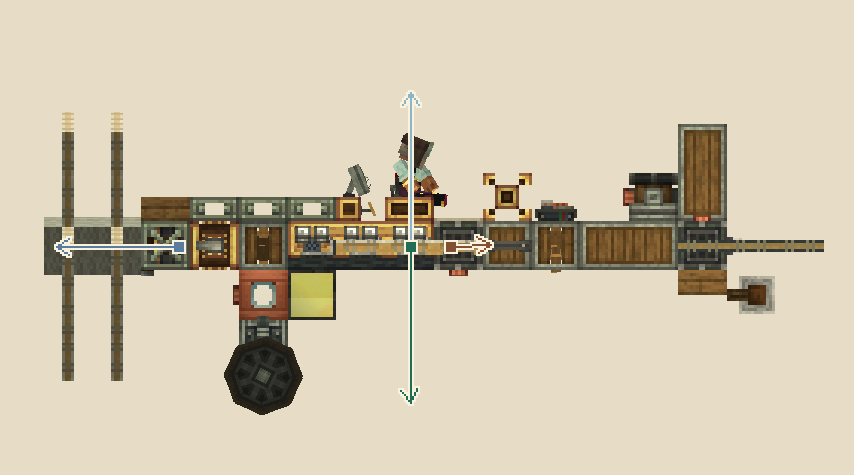
The screenshot above shows the force arrows of a Contraption Diagram: the propeller's thrust is clearly much larger than the total drag on the aircraft. If only the two forces drawn in the diagram existed, the net force would be positive and the aircraft would keep accelerating; yet the measured cruise speed stays constant (dv/dt ≈ 0). So there must be an unknown force the diagram does not draw canceling the excess thrust — that force is the universal drag:
- Direction: opposite to the velocity;
- Magnitude: proportional to mass and speed (F = −m·d·v).
It is produced by the constant velocity damping Rapier applies to every sublevel rigid body, and does not go through any force group, so neither the Contraption Diagram nor the flight-data-recorder CSV ever show it — that is exactly why "diagram net force ≠ actual net force", and why this tool exists.
Also FMC-gated (and therefore also available with an AIC), the sensor system provides a pure-math utility that computes the equivalent force of the universal (speed) drag — the constant velocity damping Rapier applies to every sublevel rigid body. It is not part of any force group, so the Contraption Diagram and the flight-data-recorder CSV never show it; this tool makes it computable for design math (net-force balance: thrust − sail drag − universal drag ≈ 0).
The formula mirrors the continuous approximation of the per-substep damping v ← v/(1+d·Δt):
| Method | Returns | Description |
|---|---|---|
getUniversalDragForce(m, V) |
number / nil | Equivalent universal-drag force scalar = m × d × |V| |
Arguments and conventions:
m— mass (kg, same units asgetPhysicsMass()/getPhysicsChainMass());m ≤ 0→nil.V— speed magnitude (m/s, same units asgetSpeed()); negative values are taken as|V|.d— the universal-drag coefficient, default 0.09 (SableDimensionPhysics.DEFAULT_UNIVERSAL_DRAG), overridable per dimension via thedimension_physicsdatapack's"universal_drag"field.- Gated exactly like the other FMC tools (the body — including constraint chains — must have ≥ 1 FMC, AIC counting as FMC; the computer must be on a body), otherwise
nil. Pure math (mainThread = false), zero main-thread scheduling.
Unlike the sail tools the result is a single per-second force (the continuous approximation is already time-normalized, no substep Δt involved) — it does not scale with air pressure, only with mass and speed.
What is cached
The coefficient d is cached once — at server start and whenever an FMC or AIC is placed/loaded (onLoad), exactly like the atmosphere-curve snapshot; if it cannot be read, the Sable default (0.09) is kept. The gate is still checked every tick.
Example
local ss = require("ccpe.sensor_system")

-- Equivalent universal drag at the current mass and speed (d = 0.09 by default)
local drag = ss.getUniversalDragForce(ss.getPhysicsChainMass(), 60)
print("universal drag (N):", drag)   -- m × 0.09 × V
Combine with
getPhysicsMass()/getPhysicsChainMass()for mass andgetSpeed()(or|v|) for speed to close the force balance:thrust − sail drag − universal drag ≈ 0in steady cruise. Sanity check with recorded values (e.g. m ≈ 45.25 kg, v ≈ 62.6 m/s → F ≈ 255 N).
Max altitude solver
This tool is only applicable to the simple aerodynamic model shown in the figure below: the thrust line passes through the center of gravity, the lift center and the weight line are aligned vertically, and the drag line basically passes through the center of gravity.
Also FMC-gated (and therefore also available with an AIC), this pure-math solver inverts the cruise equations: given the aircraft's mass, sail counts and propeller setup, it finds the highest steady-state altitude reachable at a given maximum RPM, plus the airspeed needed there.
It solves the two steady-cruise equations (level flight, airflow perpendicular to the sail normal so normal drag is zero) for the unknowns (v, P):
(1) lift = gravity:   k3·P·v·N_w                          = m·g
                      → x = P·v = m·g/(k3·N_w)            (pinned, altitude-independent)
(2) thrust = drag:    P·S^1.5·N_p·T·R·(1 − v/(S^0.5·R·A))  = k2·P·v·N_s + m·d·v
| Method | Returns | Description |
|---|---|---|
solveMaxCruise(m, wingSails, symmetricSails, propellerCount, sailsPerPropeller, maxRpm) |
table / nil | {velocity=..., altitude=...} — steady cruise state at maxRpm |
Substituting v = x/P turns equation (2) into a quadratic in P — no matrices needed (the system is bilinear in (v, P) and collapses to one quadratic):
a·P² + b·P + c = 0
a = S^1.5·N_p·T·R
b = −(S·N_p·T·x/A + k2·x·N_s)      (S^1.5/S^0.5 = S, R cancels)
c = −m·d·x
P* = (−b + √(b²−4ac))/(2a),  v* = x/P*,  altitude = inverse atmosphere curve(P*) (bisection)
N_w=wingSails— lift sails (only regular sails produce lift).N_s=wingSails + symmetricSails + propellerCount × sailsPerPropeller— the total power-block count (regular + symmetric sails + propeller power blocks), all contributing to the directionless dragk2·P·v.- Thrust model carries the airflow reduction factor
(1 − v/(S^0.5·R·A))— the fixed-wing level-flight form (θ = 90) of thegetPropellerRPMmodel: the propeller has a maximum effective speedS^0.5·R·Abeyond which thrust turns negative. - Coefficients (same sources as the other tools):
k3 = 0.475,k2 = 0.06888202261,g = 11,d = 0.09(universal drag, datapack-overridable),T = 0.2/A = 0.05(aeronautics config), atmosphere curve from the dimension datapack — all cached at server start and FMC/AIC placement. - Feasibility: returns
nilwhen the solvedP*lies outside the dimension's atmosphere range (lift too weak even at the ground, or above the atmosphere top), when the gate fails (no FMC), or when arguments are invalid (m ≤ 0,wingSails < 1,propellerCount < 1,sailsPerPropeller < 1,maxRpm ≤ 0).maxRpm = 256is only the speed cap — the stress-network capacity (getStressRemaining()) is an additional constraint.
Example
local ss = require("ccpe.sensor_system")


-- Highest steady cruise at max RPM for a given build
-- Mass 45.25 kg
-- 32 wing sails
-- 20 symmetric sails
-- 1 propeller
-- 30 power blocks per propeller
-- max RPM 256
local cruise = ss.solveMaxCruise(45.25, 32, 20, 1, 30, 256)
print("cruise speed (m/s):", cruise.velocity)
print("max altitude (Y):  ", cruise.altitude)
Use real values:
getPhysicsChainMass()form, the actual block counts of your build, and256for the RPM cap. Cross-check the result against the flight recorder for your aircraft.